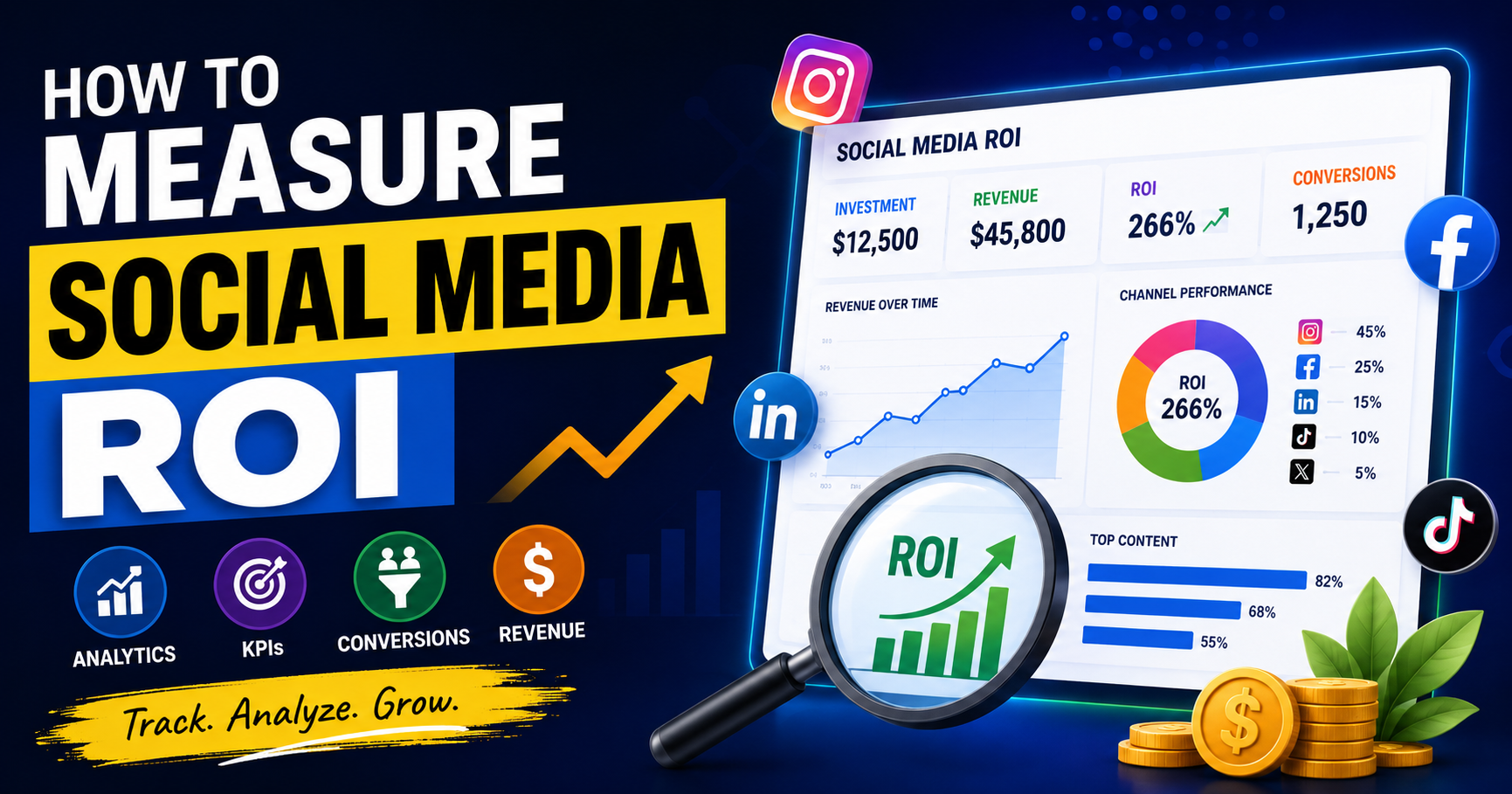
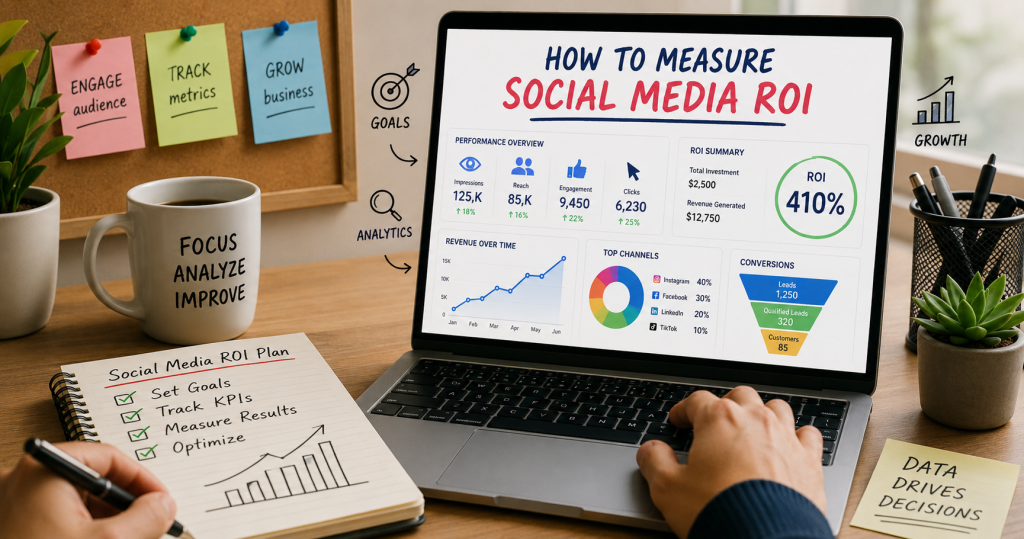
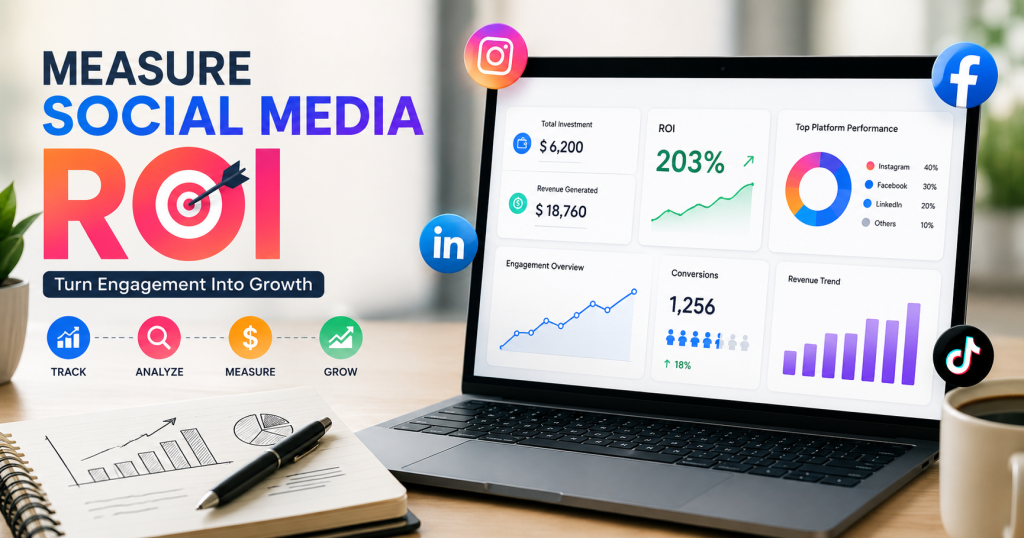
How to measure social media ROI is one of the most important questions every business should answer before investing in social media marketing. Whether your goal is to generate leads, increase website traffic, improve brand awareness, or boost sales, knowing how to measure social media ROI helps you understand what is working and where to optimize your strategy. In this guide, you’ll learn how to measure social media ROI using analytics, KPIs, conversion tracking, and proven techniques to improve your marketing performance.
What Is Social Media ROI?
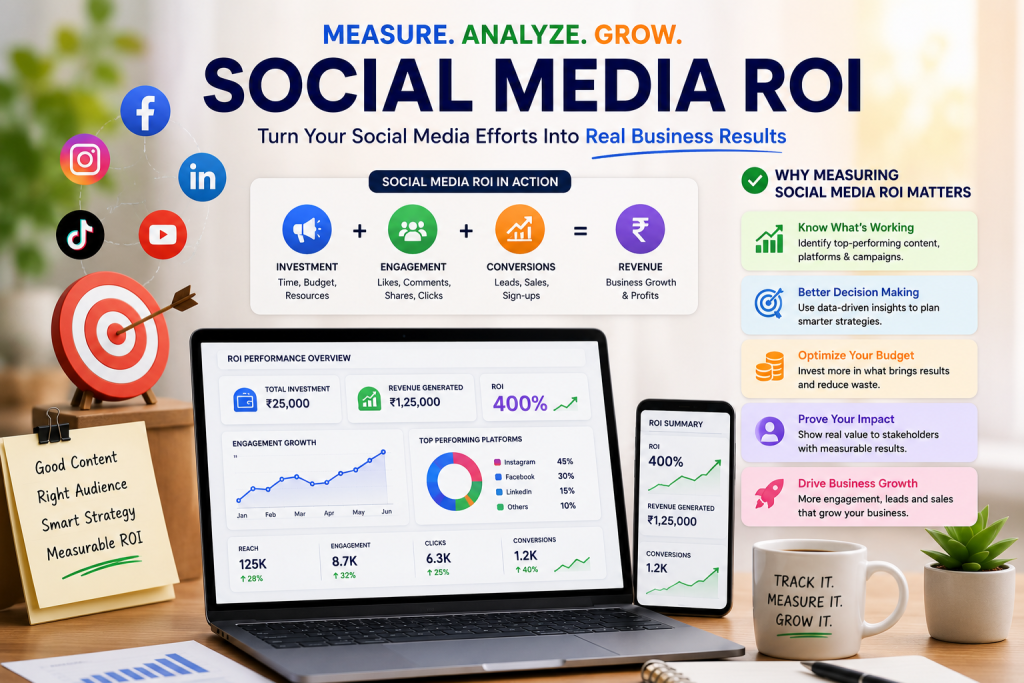
Social media ROI (Return on Investment) measures the value your business gains from social media compared to the time, money, and resources invested.
Simply put, it answers the question:
“Are my social media efforts producing profitable business results?”
Those results could include:
- More website visitors
- Qualified leads
- Sales
- Appointment bookings
- Email sign-ups
- Brand awareness
- Customer engagement
- Increased revenue
Unlike vanity metrics such as likes or follower count, ROI focuses on outcomes that directly support your business goals.
Why Measuring Social Media ROI Is Important
Businesses that track ROI make better marketing decisions because they rely on data rather than assumptions.
Measuring ROI helps you:
- Identify your highest-performing platforms
- Improve marketing performance
- Allocate budgets more effectively
- Understand customer behavior
- Optimize future campaigns
- Demonstrate marketing value to stakeholders
- Increase revenue over time
Without ROI measurement, it’s difficult to know whether your strategy is delivering meaningful results.
How to Measure Social Media ROI (Quick Answer)
Formula:
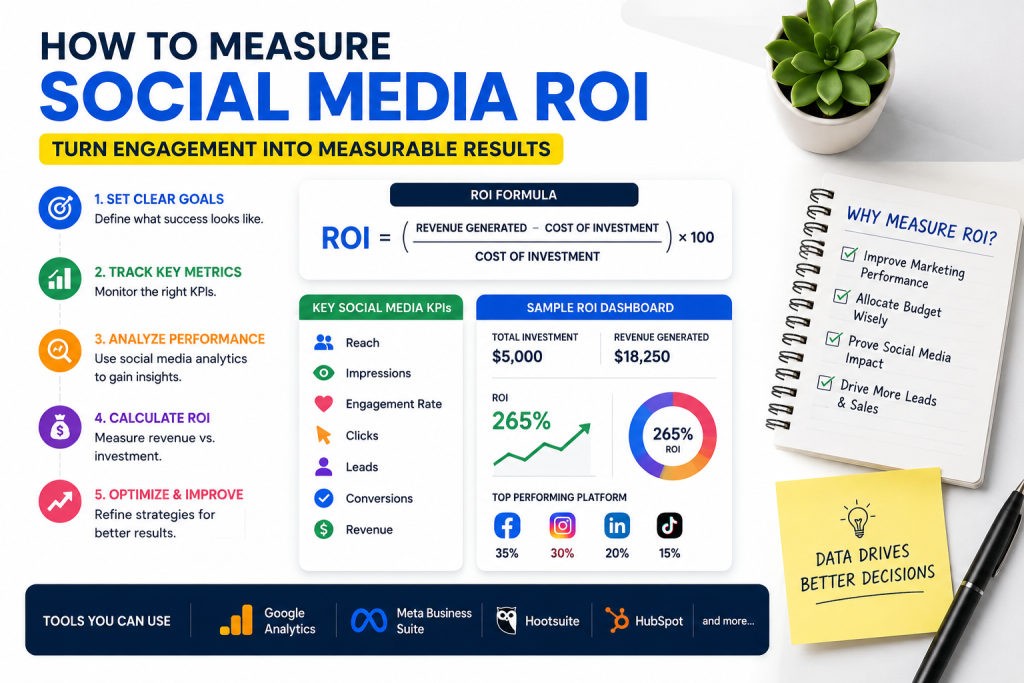
ROI = (Revenue Generated – Total Investment) ÷ Total Investment × 100
Example
Suppose you spent:
- ₹20,000 on content creation
- ₹10,000 on advertising
- ₹5,000 on design tools
Total investment = ₹35,000
Your campaign generated:
- ₹95,000 in sales
ROI calculation:
(95,000 – 35,000) ÷ 35,000 × 100 = 171.4% ROI
This means your campaign returned significantly more than it cost.
What Counts as Investment When Measuring Social Media ROI?
Many businesses only count advertising costs, but ROI should include all resources used.
Examples include:
- Paid advertising
- Graphic design
- Video production
- Copywriting
- Social media management
- Marketing software
- Employee time
- Agency fees
A complete picture leads to more accurate ROI calculations.
What Should You Measure to Calculate Social Media ROI?
Not every campaign has the same objective.
Choose metrics that align with your business goals.
If Your Goal Is Brand Awareness
Track:
- Reach
- Impressions
- Video views
- Audience growth
- Brand mentions
These metrics indicate how many people are seeing your content.
If Your Goal Is Engagement
Monitor:
- Likes
- Comments
- Shares
- Saves
- Clicks
- Engagement rate
These engagement metrics reveal how your audience interacts with your content.
If Your Goal Is Lead Generation
Track:
- Form submissions
- Direct messages
- Phone calls
- Email subscriptions
- Quote requests
These actions represent genuine business opportunities.
If Your Goal Is Sales
Measure:
- Purchases
- Revenue
- Conversion rate
- Customer acquisition cost
- Return on ad spend
This is where conversion tracking becomes essential.
The Most Important Social Media KPIs
Selecting the right social media KPIs is critical for measuring success.
Here are the most valuable ones:
1. Reach Metrics for Social Media ROI
Reach measures the number of unique users who saw your content.
Higher reach means greater brand exposure.
2. Impressions and Social Media ROI
Impressions count how many times your content appeared on users’ screens.
A single person can generate multiple impressions.
3.Engagement Rate as a Social Media KPI
Formula:
(Total Engagement ÷ Reach) × 100
A high engagement rate often indicates relevant and valuable content.
4. Website Clicks and Conversion Tracking
Track how many users visit your website through social media.
Website traffic is often the first step toward conversion.
5. Conversion Rate for Measuring Social Media ROI
Conversion rate measures how many visitors complete a desired action.
Examples include:
- Purchasing a product
- Booking a consultation
- Filling out a contact form
- Downloading a guide
6. Cost Per Lead and ROI
This KPI tells you how much each lead costs to acquire.
Lower costs generally indicate better campaign efficiency.
7. Customer Acquisition Cost (CAC) and ROI
CAC measures how much you spend to gain a new customer.
Comparing CAC with customer lifetime value helps evaluate long-term profitability.
How Social Media Analytics Helps Measure Social Media ROI
Modern platforms provide powerful social media analytics that help businesses understand campaign performance.
Analytics reveal:
- Audience demographics
- Best posting times
- Top-performing content
- Traffic sources
- Engagement trends
- Conversion behavior
Instead of guessing, analytics allow you to make informed decisions backed by real data.
How Conversion Tracking Improves ROI Measurement
Conversion tracking connects social media activity with actual business results.
Rather than only measuring engagement, you can identify:
- Which campaign generated leads
- Which platform drove sales
- Which advertisement converted best
- Which audience produced the highest ROI
Without conversion tracking, it’s impossible to accurately measure marketing effectiveness.
How Attribution Improves Social Media ROI Measurement
One customer often interacts with your brand multiple times before making a purchase.
For example:
- Sees an Instagram Reel
- Clicks your website
- Leaves without purchasing
- Returns through Facebook
- Makes a purchase
This customer journey illustrates attribution.
Attribution helps determine which marketing touchpoints contributed to the final conversion.
Understanding attribution leads to better budget allocation and smarter campaign planning.
Step-by-Step Process to Measure Social Media ROI
Step 1: Define Clear Goals
Decide what success looks like.
Examples:
- Generate 100 leads
- Increase website traffic by 30%
- Gain 500 newsletter subscribers
- Increase online sales
Clear goals make ROI measurable.
Step 2: Track the Right Metrics
Focus on metrics aligned with your objectives.
Avoid being distracted by vanity metrics that don’t contribute to business growth.
Step 3: Calculate Costs
Include:
- Advertising
- Staff time
- Creative production
- Software subscriptions
- Agency fees
Step 4: Measure Revenue or Value Generated
Determine how much revenue or business value your campaigns produced.
Examples include:
- Sales
- Qualified leads
- Bookings
- Customer lifetime value
Step 5: Calculate ROI
Use the standard ROI formula.
Track results consistently across campaigns to identify long-term trends.
Best Tools for Measuring Social Media ROI
Several tools simplify ROI measurement.
Native Platform Analytics
- Facebook Insights
- Instagram Insights
- LinkedIn Analytics
Useful for engagement and audience data.
Google Analytics
Ideal for tracking:
- Website traffic
- User behavior
- Conversion tracking
- Campaign attribution
ROI Calculator
An ROI calculator automates return-on-investment calculations by comparing marketing costs with generated revenue.
Many businesses use ROI calculators to quickly evaluate campaign profitability.
CRM Software
CRM platforms help connect leads generated through social media with actual sales, making ROI measurement much more accurate.
Common Mistakes When Measuring Social Media ROI
Avoid these common pitfalls.
Measuring only likes and followers
Popularity doesn’t always generate revenue.
Ignoring conversion tracking
Without conversion tracking, ROI calculations become incomplete.
Not setting campaign goals
Undefined goals make success impossible to measure.
Looking only at short-term results
Some campaigns build long-term customer trust rather than immediate sales.
Using too many KPIs
Focus on a small number of meaningful metrics that align with your business objectives.
Real-World Example of How to Measure Social Media ROI
Imagine a local fitness studio launches a one-month Instagram campaign.
Investment
- Content creation: ₹10,000
- Ads: ₹20,000
- Designer: ₹5,000
Total investment:
₹35,000
Results
- 180 enquiries
- 65 memberships sold
- Revenue: ₹1,80,000
ROI:
(1,80,000 – 35,000) ÷ 35,000 × 100 = 414% ROI
This demonstrates why measuring ROI provides far more insight than simply counting likes or followers.
Best Practices to Improve Social Media ROI
Follow these proven strategies:
- Set measurable goals before launching campaigns.
- Use conversion tracking consistently.
- Monitor campaign metrics weekly.
- Create audience-focused content.
- Test different creatives and messaging.
- Optimize underperforming campaigns.
- Track attribution across channels.
- Review marketing performance monthly.
- Invest more in high-performing platforms.
- Continuously improve based on analytics.
Small improvements over time often lead to substantial increases in ROI.
Frequently Asked Questions
How do I measure social media ROI?
Measure social media ROI by comparing the revenue or value generated from your campaigns with the total amount invested. Use the formula:
ROI = (Revenue – Investment) ÷ Investment × 100
Which social media analytics are most important?
The most useful social media analytics include reach, impressions, engagement rate, website traffic, conversions, audience growth, and campaign performance.
What are the most important social media KPIs?
Key social media KPIs include engagement rate, conversion rate, reach, impressions, cost per lead, customer acquisition cost, and return on investment.
Why is conversion tracking important?
Conversion tracking connects social media activity with real business outcomes such as sales, enquiries, or bookings, making ROI calculations more accurate.
Can an ROI calculator help marketers?
Yes. An ROI calculator simplifies the process of comparing campaign costs with generated revenue, helping businesses quickly evaluate marketing performance and make data-driven decisions.
Final Thoughts on How to Measure Social Media ROI
Learning how to measure social media ROI is essential for any business that wants to grow strategically. While likes and shares can indicate audience interest, they don’t tell the full story. By focusing on meaningful social media KPIs, leveraging social media analytics, implementing conversion tracking, and evaluating campaign metrics, you can clearly understand the impact of your marketing efforts.
The businesses that consistently track and optimize their ROI are better positioned to improve marketing performance, allocate budgets wisely, and achieve sustainable growth.
Ready to Maximize Your Social Media ROI?
If you’re looking to turn your social media presence into a measurable source of leads, sales, and long-term business growth, our expert team is here to help.
👉 Explore our Social Media Marketing Service: [ https://brandnova.mydt.in/social-media-management/]
We’ll help you build data-driven campaigns, monitor performance, and achieve a stronger return on every marketing investment.